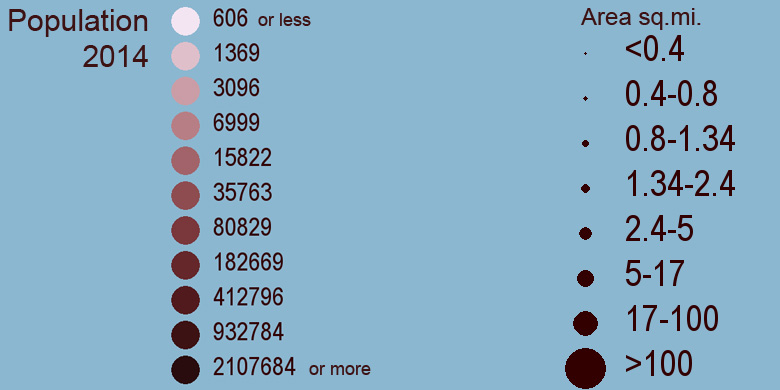
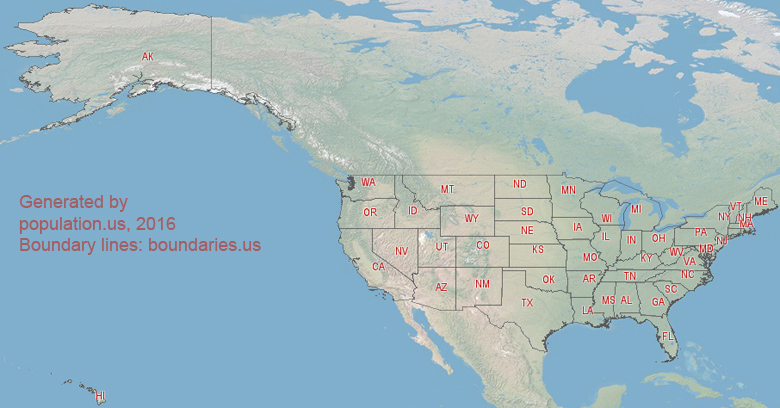
Last official estimated population of Fossil city (Wheeler County**, Oregon state) was 449 (year 2014)[1]. This was 0% of total US population and 0.01% of total Oregon state population. Area of Fossil city is 0.8 mi² (=2 km²)[6], in this year population density was 569.07 p/mi². If population growth rate would be same as in period 2010-2014 (-1.29%/yr), Fossil city population in 2026 would be 384*.
Historical population of Fossil city for period 1880-2014:
Estimated population for 2014[1]. Click on flag to hide it.
Population • Legends • Position


[1880-1890] +4.34 %/yr
[1890-1900] +6.53 %/yr
[1900-1910] +3.87 %/yr
[1910-1920] +2.11 %/yr
[1920-1930] +0.36 %/yr
[1930-1940] -0.11 %/yr
[1940-1950] +1.94 %/yr
[1950-1960] +0.41 %/yr
[1960-1970] -2.7 %/yr
[1970-1980] +0.46 %/yr
[1980-1990] -2.89 %/yr
[1990-2000] +1.74 %/yr
[2000-2005] -1.08 %/yr
[2005-2010] +1.05 %/yr
[2010-2014] -1.29 %/yr
• Heppner city population
40.2 mi,  52°
52°
• Condon city
16.5 mi,  4°
4°
• Ione city
39.8 mi,  28°
28°
• Lexington town
40.2 mi,  39°
39°
• Grass Valley city
37.3 mi,  311°
311°
• Spray town
23.5 mi,  118°
118°
• Mitchell city
29.5 mi,  174°
174°
• Antelope city
25.6 mi,  256°
256°
• Shaniko city
26.3 mi,  270°
270°
• Lonerock city
17.3 mi,  68°
68°
*Calculated by population.us from last known population growth rate, not official data.
**Some cities are placed on more than one county. Only 1 county is shown.
[1] Cities and Towns (Incorporated Places and Minor Civil Divisions) 2014, archived from the original, retrieved 02/23/2016
[2] City and Town Intercensal Estimates (2000-2010), archived from the original, retrieved 02/23/2016
[3] Places: 1990 and 1999 Populations, With Numeric and Percent Population Change, archived from the original, retrieved 02/23/2016
[4] Population of the 100 Largest Urban Places: 1980,
[5] Population of the 100 Largest Urban Places in history,
[6] Area, latitude longitude data, retrieved 02/23/2016
[7] Through the Decades, Overview 1790-2010, PDF, large files! >100 Mb
Page generated in 0.031 seconds© 2016 population.us | Terms of use | Contact
 Population.us